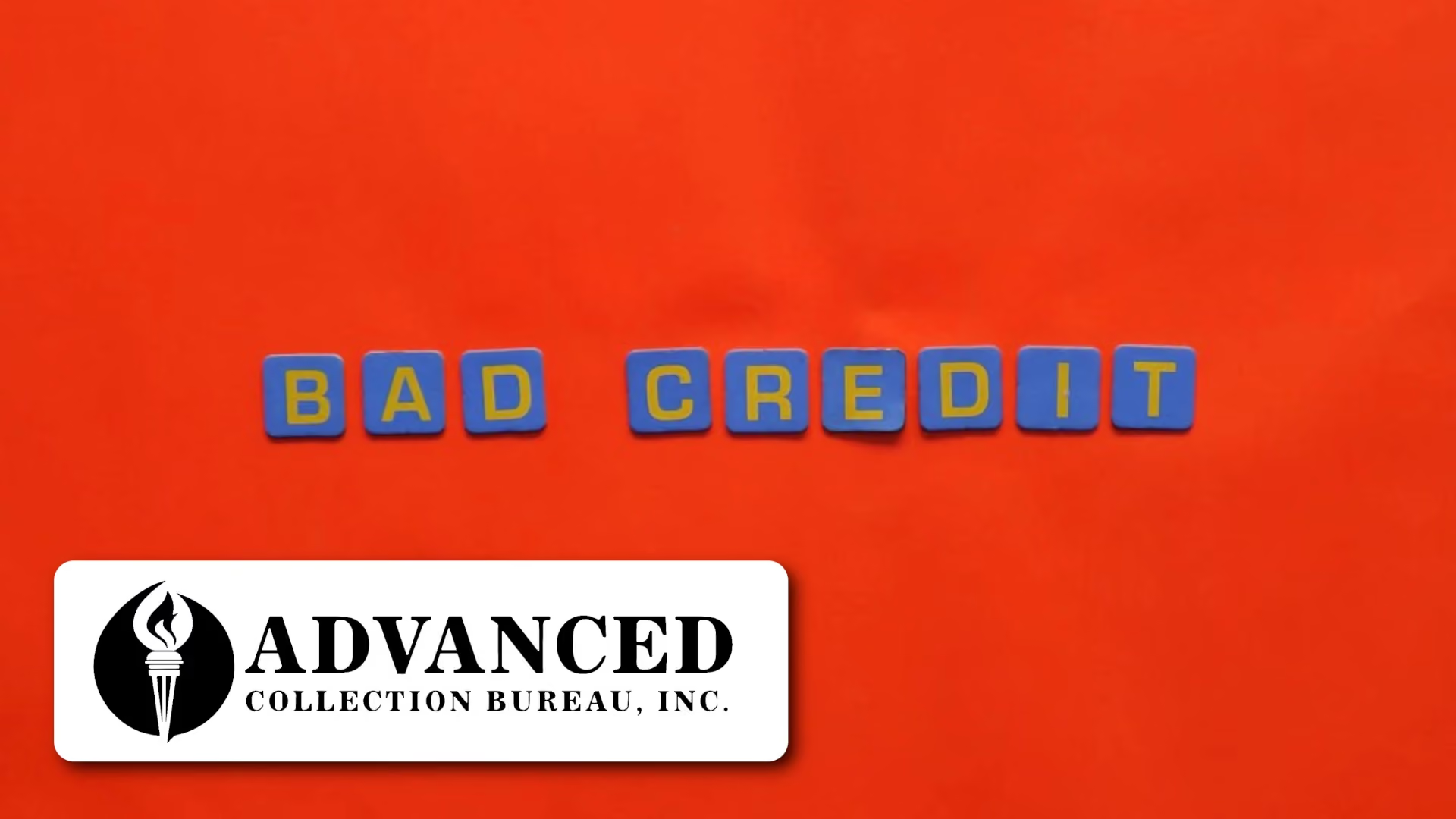
There is no single fixed number. A collection can drop your credit score a little or a lot, depending on your starting score, the rest of your credit file, whether the account is medical or non-medical, whether it is paid, and which scoring model a lender uses. FICO says paying a collection could raise your score, lower it, or have no effect at all, depending on the rest of your report. That is the clearest sign that there is no universal point loss that applies to everyone.
That is the straight answer people usually need first. If someone online promises that a collection always costs 50 points, 75 points, or 100 points, that is too simplistic. Credit scoring does not work that way. A collection is a serious negative mark, but the exact score drop varies from file to file and model to model.
Why there is no exact point drop
Credit scores are built from a full profile, not one line item in isolation. A person with excellent credit and very few negatives may see a sharper reaction to a new collection because it stands out more. Someone whose report already has several delinquencies, maxed-out cards, or prior derogatory marks may see a smaller change because the score was already under pressure. FICO explains that the impact of paying a collection also depends on the other information in the report, which supports the broader point that collection damage is highly individualized.
The scoring model matters too. Experian notes that paying collections may help scores under FICO Score 9 and 10 and VantageScore 3.0 and 4.0, but older FICO models may not give you any scoring benefit just because the collection was paid. That is one of the biggest reasons consumers get conflicting advice online. Different lenders often use different scoring versions.
A collection is still a major credit event
Even without a universal number, one thing is clear: a collection can hurt. Collection accounts are a serious derogatory item because they signal that an account went unpaid long enough to be sent out for recovery. That is why they can affect borrowing costs, approvals, apartment applications, and sometimes insurance or employment screenings depending on the situation. This is also why the idea of professional, compliant collections matters. Accurate reporting gives creditors a lawful way to pursue legitimate balances and gives consumers a reason to deal with unpaid accounts before the damage spreads.
For readers who want a broader explanation of how reporting works, ACB already has a closely related article called How Credit Bureau Collection Services Impact Your Credit, which is a natural internal link for this topic.
Paid collection or unpaid collection: does it change the score impact?
Sometimes yes, sometimes no. FICO says paying off a collection could increase, decrease, or not change the score at all. Experian says paying collections can improve scores under some newer models, while older models may continue to treat a paid collection much like an unpaid one. That means paying is not a guaranteed instant score fix, but it can still be an important financial and legal step.
This is where a lot of consumers get tripped up. They hear that paying will not delete the collection, then assume paying never matters. That is not right either. Paying or settling can still stop active collection pressure, reduce legal risk on some accounts, show future housing or lending reviewers that the balance is resolved, and potentially help under certain scoring models. It just may not produce one clean, predictable point gain across every score.
ACB has another strong internal resource here: How to Pay Off Debt in Collections Without Hurting Credit. It fits well because many readers asking about score drops are really trying to decide what to do next with the account.
Medical collections are different
Medical collections deserve their own section because the rules are different enough to change the answer. The CFPB states that paid medical collections, medical collections under $500, and medical collections less than one year old should no longer appear on consumer credit reports under the nationwide credit reporting companies’ current policies. TransUnion and Equifax describe the same framework.
That means a medical collection may have no score impact at all if it falls into one of those excluded categories. The CFPB also found that removing low-balance medical collections improved many consumers’ FICO Score 8 results, with average gains around 20 points when all medical collections were removed for the affected group in that analysis. That does not mean every medical collection costs exactly 20 points, but it shows that score changes can be meaningful when a reported collection disappears.
Because rules around medical debt have changed several times in recent years, it is smart to check your reports directly instead of assuming an old collection should still be there. The CFPB recommends reviewing your credit reports through AnnualCreditReport.com, and notes that the major bureaus are offering free online credit reports weekly.
How long does the damage last?
For most collection accounts, the reporting timeline is generally up to seven years from the original delinquency date. That does not mean the score impact stays equally severe the entire time. In practice, more recent negative information often hurts more than older negative information, although the collection can remain a drag on the file while it is still reportable. This timing issue is one reason early action matters for both consumers and creditors.
If the account is inaccurate, though, you do not have to wait years. You can dispute incorrect information with the credit bureau and the furnisher. ACB’s How to Dispute a Debt Collection Claim is a relevant internal link for that exact scenario.
What should you do if a collection appears on your report?
Start by pulling your credit reports and confirming the account details. Check whether the debt is really yours, whether the balance is accurate, whether the dates make sense, and whether it is medical or non-medical. The CFPB specifically advises consumers with medical debt to review reports for items that should no longer be showing.
If the account is wrong, dispute it. If it is valid, think strategically instead of emotionally. A rushed payment without verification is not always the best move, but ignoring a legitimate collection can also make things worse. The right answer may be to validate the account, negotiate a settlement, pay it, or address other score factors at the same time such as credit card utilization and on-time payments. FICO’s own explanation supports this idea because the effect of a collection depends on the rest of the report, not the collection alone.
For readers worried about scams before they pay anything, ACB’s How to Identify and Avoid Fake Debt Collection Calls is another smart internal link because not every collection demand is legitimate.
What people are really asking behind this question
A lot of people who search this topic are not just asking for a number. They are usually asking one of three bigger questions.
The first is, “Is my credit ruined?” Usually not. A collection hurts, but credit can recover over time, especially if you prevent new late payments, keep revolving balances under control, and deal with the collection intelligently. FICO’s own guidance makes clear that the impact of any one collection depends heavily on the rest of the file.
The second is, “Should I pay it?” Often yes if the debt is accurate and the strategy makes sense, but not because of a guaranteed magic point increase. The reason to pay may be to resolve the balance, prevent escalation, improve underwriting optics, or help newer score models.
The third is, “Will it stop me from getting approved for something important?” It can definitely make approval harder. Landlords, lenders, and other decision-makers may view a collection as a sign of elevated risk. That is why ACB writes so much about both sides of the issue: consumers need clear information, and businesses need compliant recovery tools that keep legitimate balances from turning into long-term losses.
A fourth internal link that fits nicely here is What Debt Collectors Can and Cannot Do, since many readers dealing with credit score damage are also trying to understand their rights during collection contact.
Why this still supports professional collections
Being honest about score uncertainty does not weaken the case for collections. It strengthens it. The reality is that credit reporting and collection activity work best when they are accurate, compliant, and professional. Creditors should be able to recover legitimate debt. Consumers should be able to verify, dispute, and resolve accounts without deception or confusion. That is the standard Advanced Collection Bureau stands for.
ACB is pro collections because landlords, property managers, healthcare providers, and businesses should not be forced to absorb unpaid balances forever. At the same time, ACB is pro accuracy and pro compliance. That balance is what gives the system credibility. For companies that need a recovery partner with real process and real accountability, Work With Us is the right place to start. You can also reach out through Contact.
The bottom line
A collection does not drop everyone’s credit score by the same number of points. The impact varies based on your credit file, the type of collection, whether it is medical, whether it is paid, and which scoring model is being used. For some people the damage is modest. For others it is significant. The safest answer is not a neat number. It is that collections can hurt a lot, but the exact drop is personal and model-specific.
If a collection has appeared on your report, check the details before reacting. Pull your reports, verify the account, dispute errors, and handle valid debts strategically. For businesses that want to recover accounts the right way while protecting compliance and reputation, ACB is built for that job.
The content, information, and templates provided by Advanced Collection Bureau, Inc. — including but not limited to articles, rental applications, lease agreements, and notice forms — are intended for general informational and educational purposes.
They are not legal advice and should not be relied upon as such. The information is general in nature and may not reflect the most current legal developments or account for the specific requirements of your state, city, or municipality.
Use of this content or any associated templates does not create an attorney-client relationship between you and Advanced Collection Bureau, Inc. We make no warranties or representations as to the accuracy, completeness, suitability, or legal enforceability of any content or document provided. Advanced Collection Bureau, Inc. is not a law firm or an attorney.
By accessing, downloading, or using any material from this website, you acknowledge and agree that you are solely responsible for ensuring compliance with all applicable U.S. federal, state, and local laws, and that you will seek guidance from a qualified legal professional as needed.
Advanced Collection Bureau, Inc., its affiliates, and contributors expressly disclaim any and all liability for any loss, damage, or claim arising out of or in connection with the use or misuse of the content, advice, and templates provided.