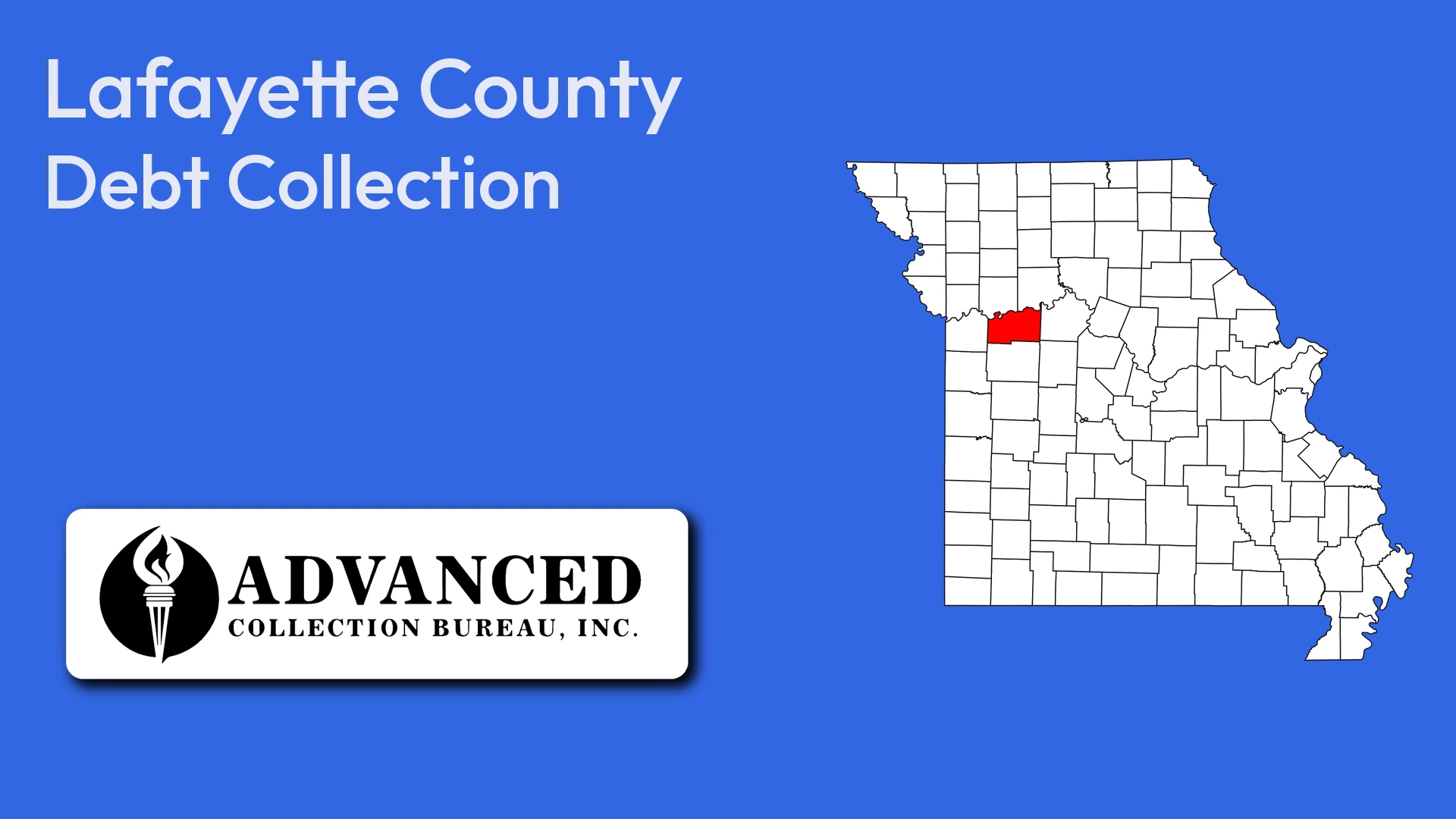
Lexington's Main Street county offices serve Lafayette County owners. ACB helps landlords pursue documented rent, damage balances and rental judgments.
Lexington is the Lafayette County seat, with Higginsville and Odessa among the county's other communities. The county office directory places key property offices on Main Street in Lexington. Whether an owner manages a single home or several buildings across these communities, an unresolved account deserves a documented handoff after the tenancy ends.
ACB assists individual landlords, apartment owners, property managers, real estate investors and small portfolio owners. Rental accounts may include unpaid rent, supported lease-break charges, damage exceeding the deposit, lease-based utility or fee balances and unpaid rental money judgments. Each charge should have an explanation and supporting records, with all payments and credits reflected in the remaining total.
The Missouri Department of Agriculture's Lafayette County economic profile identifies crops, livestock, food processing and related industries as contributors to the local economy. This is useful background for a county whose communities serve both town residents and surrounding rural areas. It does not tell an owner why an individual resident missed a payment; that account history comes from the lease and communications.
For an owner with properties in Lexington and Odessa, consistent records are more useful than assumptions about occupation or income. Keep each tenancy's payment dates, adjustments and correspondence together. Like separating the records for different parts of an agricultural business, a well-organized portfolio makes it easier to see which amount belongs to which account.
ACB follows the FDCPA and applicable Missouri law. The Attorney General's landlord and tenant resource supplies general background for owners reviewing their rental documentation and collection practices.
The Lafayette County office listing identifies the Assessor, Recorder and Circuit Clerk separately. Assessment and parcel questions belong with the Assessor; recorded deeds belong with the Recorder of Deeds. The Circuit Clerk's court-record role is distinct from both. Property records can assist with identification, but the lease and ledger support a tenant balance.
Use the Missouri Judiciary directory for Circuit Court contacts and local court information. Rental claims may involve the Circuit Court's associate circuit or small claims divisions depending on the claim. Possession of a rental and a post-move money claim require different consideration. An attorney should address venue, amount, eligibility, disputed charges and enforcement, including restrictions on assigned claims in small claims. ACB does not handle evictions or represent landlords in court.
Before submitting an account, gather the signed lease, amendments, dated ledger, deposit reconciliation, inspection photographs, invoices and relevant correspondence. Add any judgment and later payments. Explain adjustments in a short chronology so a person who never managed the property can understand how the current balance was reached.
When an owner handles the bookkeeping personally, it can help to describe each adjustment in ordinary language beside the date and amount. Explain a refunded charge, an applied credit or a payment received after the final statement. Preserve the earlier statement as well as the updated ledger. That record of changes gives the reviewer a clearer account than a replacement total with no explanation of how it was calculated.
Yes, ACB can discuss a documented account from an individual rental owner. A complete lease and current balance history are more useful than the number of properties in the portfolio.
Provide condition photographs, inspection notes and itemized repair invoices with the deposit accounting. Separate the supported tenant charge from routine maintenance or improvements so the amount has a clear basis.
No, a money judgment records an award but does not itself mean payment has arrived. Include the judgment and all subsequent payments when discussing the amount that remains unpaid.
Advanced Collection Bureau is based in Florida and serves clients nationwide with more than 25 years of experience. Skip tracing can help locate former residents, and eligible accounts may be reported to credit bureaus twice monthly. ACB works on contingency, with no collection fee unless it collects.
In a hypothetical Lexington case, a small landlord has unpaid rent and a documented repair balance after move-out. The owner applies the deposit, attaches the invoice and photographs, and records a later payment before submitting the file. ACB can review that reconciled account while the landlord focuses on the next tenancy.
A complete ledger serves the same purpose as organized business records: it makes the underlying activity visible. Contact ACB about Lafayette County rental balances and provide the documents needed for an informed collection review.
Unpaid debts should not slow down your business.
We specialize in professional and compliant debt recovery, helping you maximize recoveries while maintaining strong customer relationships.
Our risk-free, results-driven approach ensures you only pay when we collect.
Explore the right approach for your residential portfolio.

Help your on-site and regional teams move past repeated follow-up. ACB pursues unpaid rent and documented move-out balances with professional communication and clear account reporting.

Managing homes across multiple addresses is demanding enough. ACB helps rental management teams pursue former-resident balances with a clear handoff, professional outreach, and account reporting.

Student leases, guarantor records, and seasonal turnover need a careful handoff. ACB reviews the account documentation and pursues unpaid balances through professional communication.
We're proud to serve over a thousand property management companies, landlords, and real estate owners. From small independent operators to large multi-property firms, we provide reliable, effective debt recovery.
For a quarter century, we've specialized in recovering residential rental debt. Our time-tested, ethical approach leverages deep industry expertise to get results while preserving tenant relationships.
We have successfully recovered over 85 million dollars in delinquent rent, fees and damage charges for our clients. Our advanced skip tracing and persistent efforts maximize the funds returned to your business.



Advanced Collection Bureau specializes in managing residential collections with a focus on maintaining positive relationships between property managers and tenants. Our experienced team understands the unique challenges of residential collections and employs proven strategies to recover debts efficiently.
Our approach includes personalized communication with debtors, flexible payment plans, and a thorough understanding of the legal requirements specific to residential collections. By partnering with us, you can expect increased recovery rates and reduced delinquencies, ensuring your property management operations run smoothly.

No one chooses to get sick, but they still need your services. We take a compassionate approach to medical collections, and our system works. We believe that friendly debt collectors do exist, and we have them on our team. Advanced Collection Bureau recognizes the sensitive nature of medical debt and strives to provide respectful and empathetic service to patients while ensuring healthcare providers receive the payments they are owed.
Our medical collections process involves clear communication, patient education on their financial responsibilities, and offering manageable payment solutions. We are compliant with all relevant healthcare regulations and ensure that the dignity and privacy of patients are preserved throughout the collections process.

Contractors and service providers alike can rejoice - we'll ensure what needs to be paid gets paid. Advanced Collection Bureau is dedicated to supporting contractors and service providers in recovering outstanding payments for their hard work. Our team understands the unique challenges faced by contractors, including project-based billing and delayed payments, and employs effective strategies to address these issues.
We offer a seamless process that includes thorough account reviews, consistent communication with clients, and legal support if necessary. Our goal is to minimize the financial strain on your business and ensure that you receive timely payments for the services you provide, allowing you to focus on growing your business and delivering quality work.

We believe that every client and every account is unique. That's why we take a customized approach to debt recovery, tailoring our strategies to fit the specific needs of each situation.
"Our company has used Advanced Collection Bureau for well over 10 years. They are very well versed in the collection industry and are a pleasure to work with.
I highly recommend this company and its services to any company looking for assistance with collecting past due debts.
Our representative, Dianna, is personable and attentive to her clients. She is very much appreciated for her efforts to get our debts collected."

"This letter is in reference to Advanced Collection Bureaus performance. Wells Boys and Girls Property Management have been using ACB for all of our collection needs. ACB has proved to be an excellent choice for all of our collection needs.
We have seen a noticeable increase in profits and professionalism. If you have any concerns or questions regarding the performance of ACB please feel free to contact us."
.avif)
"Matt at Advanced Collection Bureau assisted me with settling my debt with a poorly managed apartment complex.
After speaking to him for a few minutes he was able to send me the bill that the apartment complex never did."

"What a pleasant phone call I had with Jim! He was friendly, shared with me new laws regarding medical bills and my credit, as well as taking my bill down.
I paid it off today and on 2/1, it will disappear from my credit report. Woot! Thank you Mr. Richards!"

"Sam was very friendly, had a great sense of humor and actually made the phone call very pleasant.
Forgot I was even paying a collection bill and felt like I was talking to a long time friend. Got to pay off the debt and got an email verification. Hope to never speak to you again Sam!"



Trust our team for your debt resolution.