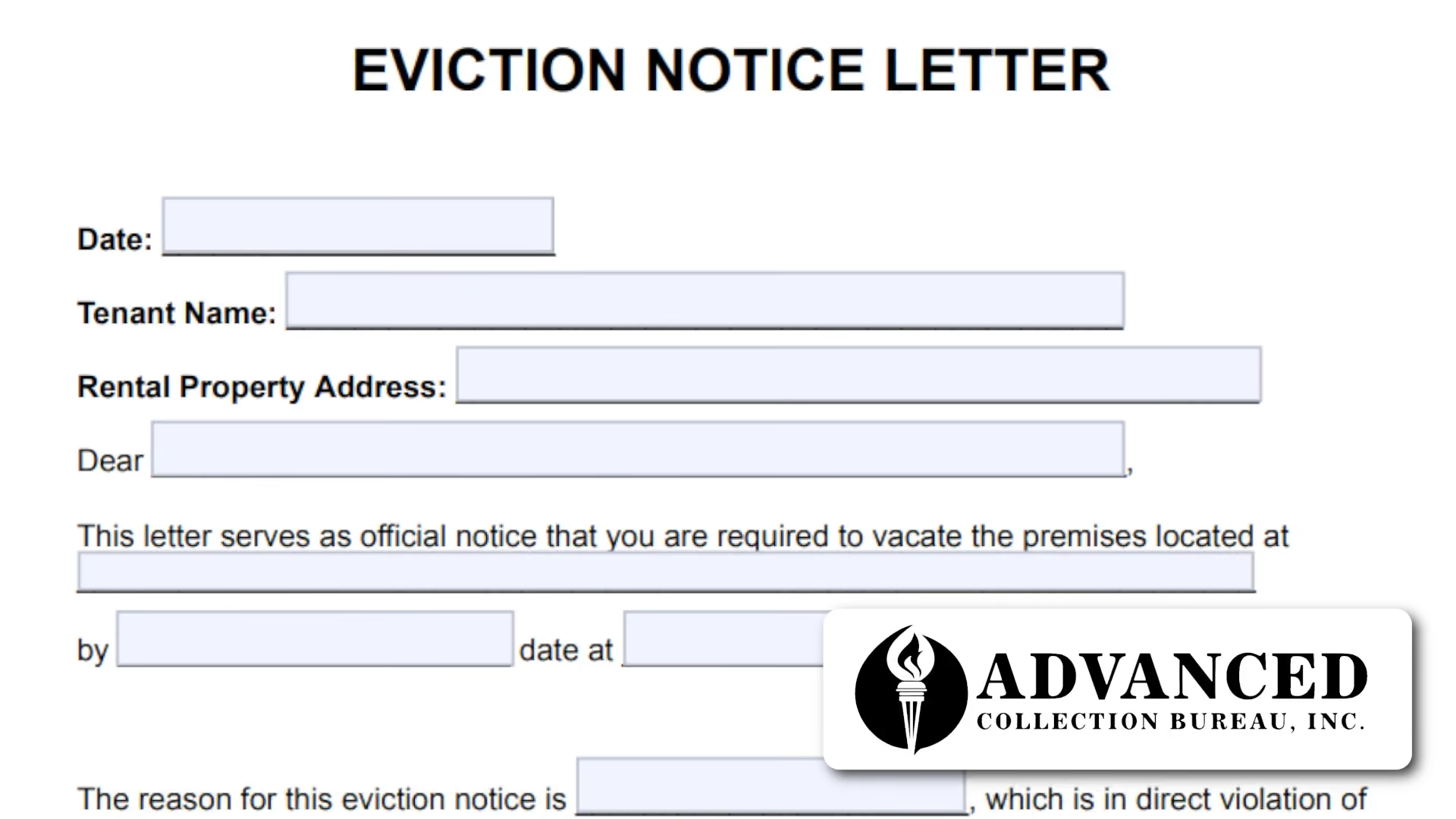
Rent didn't arrive? Build the right notice in minutes: a warm friendly reminder for a usually-reliable tenant, or a formal Notice to Pay or Quit with an itemized balance, your state's cure period, the computed deadline date, and a Certificate of Service block. Preview the notice live as you type, then print it, save it as a PDF, or copy the text, all 100% free with no signup and no email wall.
A late rent notice that holds up needs: the tenant's full name(s) and the property address; the date rent was due and the date the notice is served; an itemized breakdown of what's owed (rent, late fees the lease actually allows, returned-payment fees) minus any partial payments received; a clear total amount due; exactly how and where to pay; and, for a formal notice, the statutory demand to pay within your state's cure period or surrender possession, plus a Certificate of Service recording how and when the notice was delivered. The generator assembles all of it from a short form and computes the deadline date for you. One thing to skip: threats or amounts your lease doesn't support; they weaken your position if the case ends up in front of a judge.
If rent is a few days late from a tenant who normally pays, start with a friendly reminder: it preserves the relationship, collects most late rent on its own, and includes the graceful "if you've already sent payment, please disregard" line. A formal Notice to Pay or Quit is the legal escalation, a statutory demand that starts the clock on your state's cure period and is usually a required first step before filing an eviction for nonpayment. Many landlords send the friendly version the week rent goes late and the formal version once the lease grace period has clearly passed. The generator builds both from the same information, so switching takes one click.
The "cure period" is how long state law gives a tenant to pay (or move out) after a pay-or-quit notice is served, and it ranges from 3 days to 30 days depending on the state. Short-fuse states like Texas, Florida, and California use 3-day notices (Florida and California count business/court days, so weekends do not count, and California also excludes judicial holidays). Mid-range states like Arizona, Virginia, and Illinois use 5 days; Kentucky and Michigan 7; Colorado, Maryland, and North Carolina 10. Tenant-protective states like Massachusetts, New York, and Washington require 14 days, and the District of Columbia requires 30. A few states (Georgia, Missouri, West Virginia) set no fixed statutory period, and Oregon counts in hours (72-hour and 144-hour notices). Select your state in the generator to see its period and a computed deadline date, and always verify current law before serving, because cure periods change and some cities layer on extra requirements.
Service method matters as much as the notice itself; using the wrong one can restart the clock or get an eviction case dismissed. Most states accept one or more of: hand delivery to the tenant (the gold standard); posting on the door plus mailing a copy (often allowed only after attempting personal delivery); and certified mail with return receipt, which some states require and others treat as adding days to the deadline. Check your lease too: many leases specify a notice method, and you must follow it. Whatever you choose, document it: the generator includes a Certificate of Service block where the person serving the notice records the method, date, and signature, plus take a timestamped photo if you post it. Verify your state's accepted methods before serving.
If the tenant pays within the cure period, the matter ends; accept the payment and keep the paper trail. If they don't, the notice becomes your evidence: the next step is filing an eviction (unlawful detainer) case in your local court, where the properly served notice and its deadline are usually the first things the judge checks. Winning gets you possession back, but most eviction judgments don't get the money back, because the tenant has already moved on. That's where collections comes in: a collection agency that specializes in rental debt can locate the former tenant, report the debt, and recover unpaid rent, fees, and damages. Advanced Collection Bureau works on contingency (no recovery, no fee), so there's no cost to placing the account.
Yes. 100% free, no account, no email, unlimited use. It's part of Advanced Collection Bureau's free toolkit for landlords and property managers, and nothing you type leaves your browser.
In nearly every state, yes. A properly served pay-or-quit (or equivalent demand) notice is a prerequisite to an eviction filing for nonpayment, and courts dismiss cases over defective notices. A few states (like New Jersey and West Virginia) handle nonpayment differently, so verify your state's current requirements before filing.
A friendly reminder, sure. A formal Notice to Pay or Quit usually can't be served by email or text alone; most states require hand delivery, post-and-mail, or certified mail, unless your lease and state law expressly allow electronic service. Send the email as a courtesy copy, not as service.
Only fees your lease actually authorizes, and within any state cap. Some states also limit whether a pay-or-quit notice can demand fees on top of rent, so when in doubt, demand the rent and bill the fees separately. The generator itemizes each charge so the total is transparent.
Be careful: in some states accepting partial payment after serving a pay-or-quit notice waives the notice and you must re-serve. The generated formal notice includes a reservation-of-rights paragraph, but check your state's rule before taking partial payment, and log it as a payment-received credit if you re-issue.
That's exactly what Advanced Collection Bureau does. Once the tenant is gone, send the file (ledger, lease, notices) to ACB. We've recovered over $85 million in unpaid rent, fees, and damages for landlords and property managers, on contingency: no recovery, no fee.
Let our experts help you recover lost
revenue and improve your financial stability.


We're proud to serve over a thousand property management companies, landlords, and real estate owners. From small independent operators to large multi-property firms, we provide reliable, effective debt recovery.
For a quarter century, we've specialized in recovering residential rental debt. Our time-tested, ethical approach leverages deep industry expertise to get results while preserving tenant relationships.
We have successfully recovered over 85 million dollars in delinquent rent, fees and damage charges for our clients. Our advanced skip tracing and persistent efforts maximize the funds returned to your business.